
Sports Betting App Development: Building the Digital Sportsbook
Sports betting app development is the specialized process of creating digital platforms that allow users to place wagers on sporting events through a mobile interface . The global sports betting market is experiencing explosive growth, driven by increased smartphone penetration, the expansion of legalized betting in new markets, and the demand for live, in-play betting experiences.
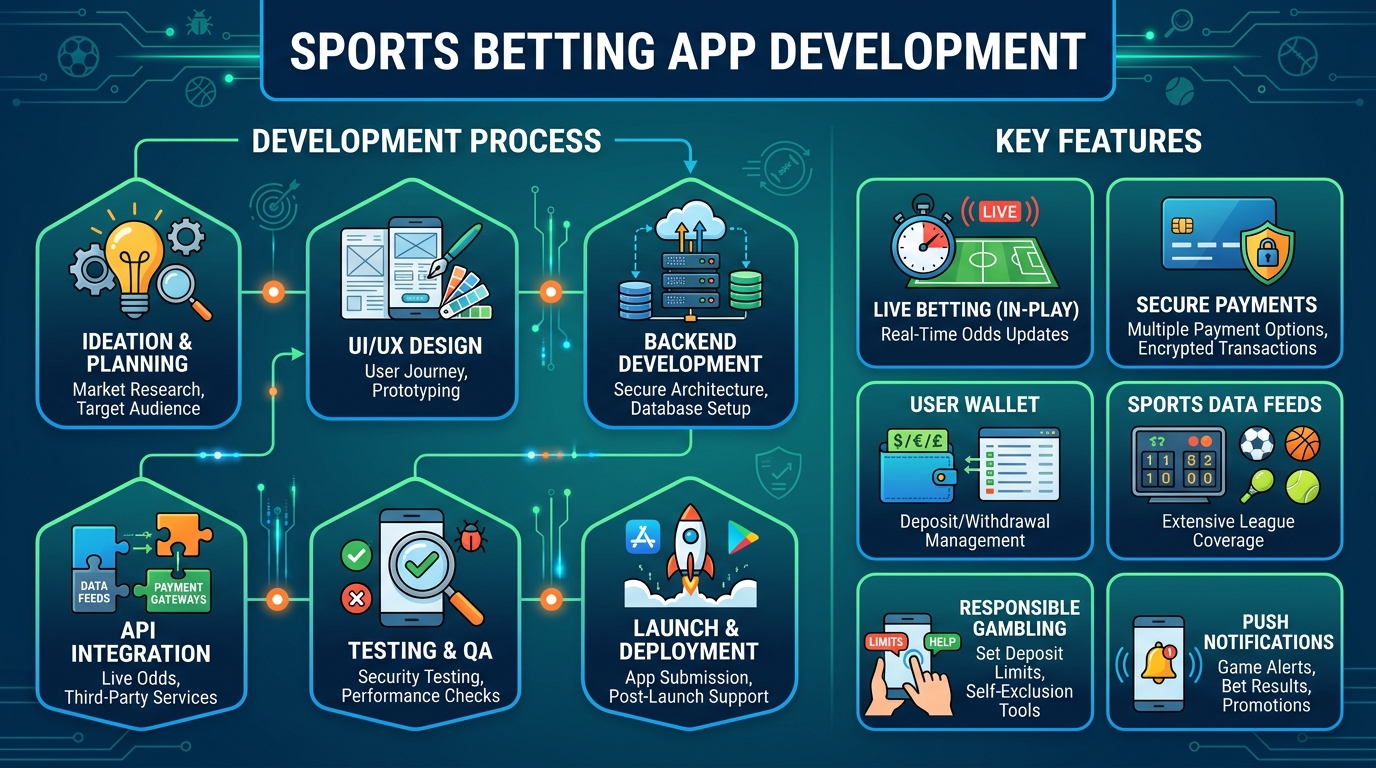
A successful sports betting app is not just a betting tool—it is a live engagement platform combining sports content, real-time data, promotions, and account services in one place. This all-in-one function depends on several systems working together behind the scenes: live odds feeds, event data providers, identity verification tools, payment gateways, fraud detection systems, and geolocation technology .
What is a Sports Betting App?
A sports betting app is a digital sportsbook for mobile devices that lets users view upcoming games, compare betting options, and place wagers on their predictions. Common markets include match winners, point spreads, totals, player performance outcomes, and in-play bets placed during a game .
Core Stakeholders
StakeholderRoleEnd UsersPlace bets, track wagers, manage accounts, view live events and oddsAdmins/OperatorsManage odds, users, payments, compliance, and analyticsThird-Party Data ProvidersSupply live scores, odds feeds, and event data
Core Features of a Sports Betting App

For Users
FeatureDescriptionEvent ListingsUpcoming and live sporting events across leagues and competitions Odds and MarketsDifferent bet types and real-time pricing Bet SlipA space where users review and confirm selections Wallet and PaymentsDeposit, withdrawal, and transaction history tools Live Betting FeaturesIn-play wagering, live stats, and rapid odds updates Push NotificationsPromotions, score updates, and betting alerts Cash OutEarly payout on bets before they settle
For Admins
- User Verification: Identity, age, and location checks (KYC/AML)
- Responsible Gambling Controls: Deposit limits, time reminders, and self-exclusion tools
- Analytics and Reporting: Track user behavior, revenue, and risk
- Risk Management: Fraud detection, odds management, and trading operations
Technical Architecture: The Engine Behind the App

A sports betting app is one of the most complex applications to build, combining real-time data processing, financial transactions, and regulatory compliance.
Architectural Approach
The recommended approach is an event-driven, microservices architecture . This allows operators to handle spiky, seasonal traffic (e.g., major sporting events) by scaling services independently . Traditional monolithic sportsbook applications often struggle with these traffic spikes .
Technology Stack Recommendations
LayerOptionsFrontendReact.js, Angular ; Kotlin + Jetpack Compose (Android) BackendASP.NET Core (performance, concurrency), Java Spring Boot (complex workflows), Node.js (real-time, event-driven) DatabasePostgreSQL (transactions, reporting), MS SQL Server (enterprise), MongoDB (unstructured data), Redis (caching) Message BrokersRabbitMQ (real-time messaging), Kafka (high-throughput event streaming) InfrastructureContainerization (Docker, Kubernetes); Serverless (AWS Lambda) for infrequent workloads CloudAWS (with reference architecture available), Azure, GCP
Microservices Architecture Example
A production sportsbook might be composed of the following microservices:
- Auth Service: User authentication and authorization
- Betting Service: Manages betting operations
- Live Market Service: Handles live market data
- Sporting Events Service: Manages sporting event data
- Third Party Service: Integrates with odds and data providers
- Trading Service: Manages trading operations and risk
- User Service: Handles user management
- Wallet Service: Manages user wallet operations
Development Process

1. Define Core Features and Business Model
Start by defining the scope and feature set. For an MVP, focus on essential features: event listings, odds and markets, bet slip, wallet and payments, and user verification .
2. Technology Selection
Choose the tech stack based on scalability needs. Event-driven microservices are the recommended pattern . For Android, Kotlin + Jetpack Compose is a modern choice .
3. Compliance and Regulation
In regulated markets, apps must comply with licensing requirements, age restrictions, responsible gambling policies, and anti-money laundering requirements . Geolocation technology is also required where location-based access control is mandated .
4. Security Implementation
Sports betting apps handle sensitive financial transactions and personal information. Essential security features include:
- Encryption and secure authentication
- Fraud detection systems
- Two-factor authentication
- PCI DSS compliance for payments
5. Deployment and Scaling
Use cloud-native development and containerization for faster deployments and scalability. Infrastructure as Code (Terraform, Ansible) is recommended for managing infrastructure across environments .
Cost Estimates (2026)
Development costs vary based on complexity, features, and platform requirements.
Cost Ranges
Complexity LevelEstimated CostKey FeaturesMVP/Basic (Script or Simple Build)$5,000 – $50,000Core features: registration, basic odds, bet slip, simple wallet. Ready-made scripts start around $5,000 Mid-Level Platform$80,000 – $150,000Live betting, real-time odds, multiple sports, bonus management, secure payments Enterprise-Grade Solution$150,000 – $300,000+Advanced analytics, risk management engines, AI-powered personalization, scalable cloud infrastructure, custom microservices architecture
Cost Drivers
- App Features: More advanced functionality = more development time
- Security: Encryption, fraud detection, and compliance integrations add to upfront costs but protect the platform
- Scalability: Infrastructure must support thousands of concurrent users during major events
- Team Location: Development costs in India are generally more affordable; US-based teams may charge higher rates but offer deeper regulatory knowledge
The AI Future of Sports Betting Apps
AI is transforming the iGaming industry. Future sportsbooks will offer:
- Personalized odds and offers based on user behavior
- Real-time fraud detection using AI-driven anomaly detection
- AI chatbots for enhanced customer experience
- Dynamic personalized content for richer engagement
- AI-powered bet extraction: Apps like BetSnap now use Google Gemini AI to extract bet details from betting slip screenshots
Conclusion
Sports betting app development is a complex but high-reward venture. Success demands a robust event-driven architecture, real-time data integration, stringent security, and regulatory compliance. By starting with a focused MVP, leveraging modern frameworks, and building on scalable cloud infrastructure, businesses can create platforms that capture the growing demand for mobile sports betting.