
Predictive Analytics: From Data to Foresight
Predictive analytics is an advanced branch of data science that uses historical data, statistical algorithms, and machine learning techniques to forecast future events, behaviors, and outcomes . It answers the question: "What is likely to happen?" .
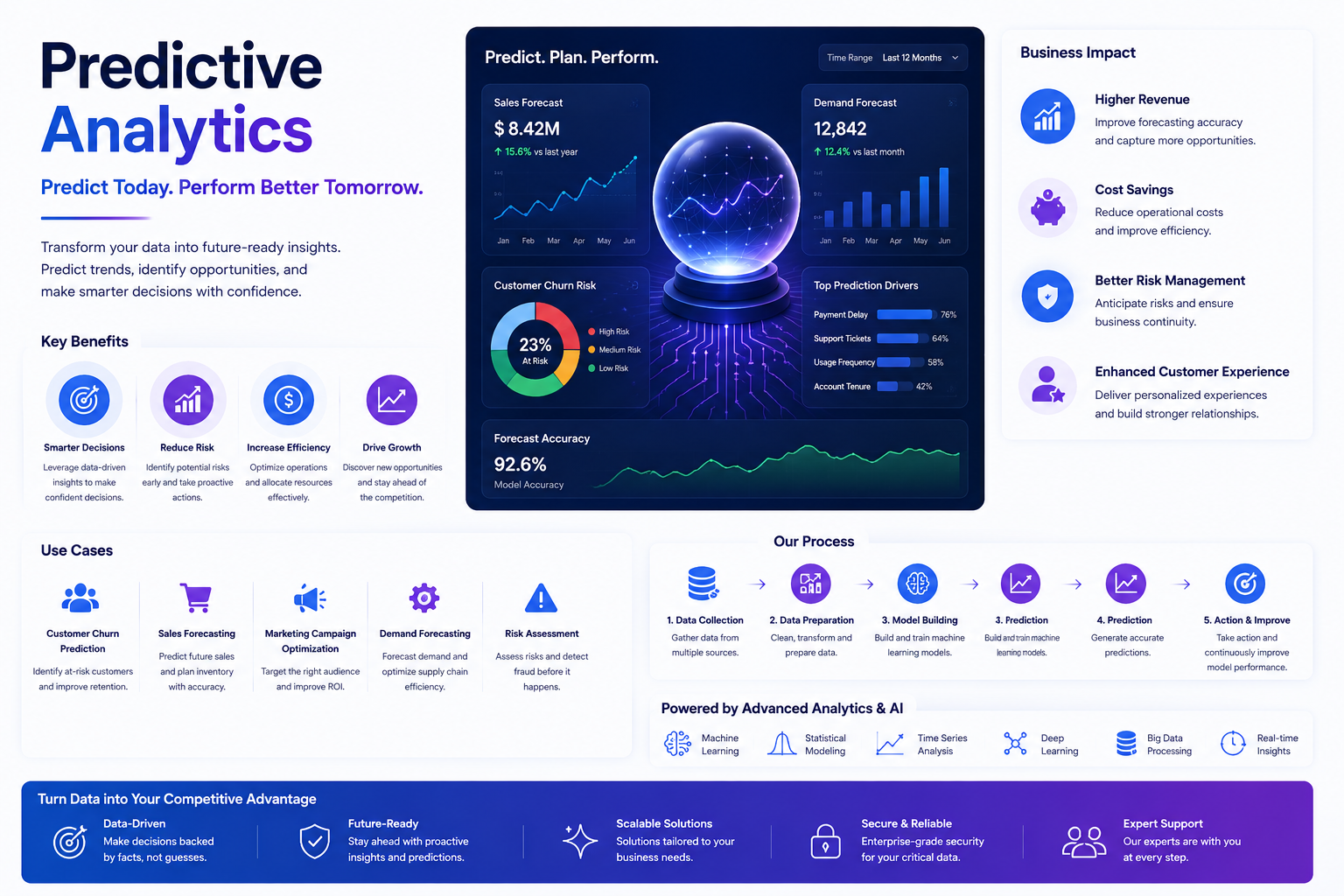
It's the key to moving your organization from being reactive to proactive. Instead of just reporting on what happened in the past, you can anticipate what's coming next.
Why Predictive Analytics Matters: From Insight to Foresight
Understanding what went wrong is a must for every business. But identifying what might go wrong—or perform well—equips organizations with the strategies to avoid or achieve those predicted outcomes .
The real-world impact is significant. Businesses can use predictive analytics to:
- Detect Fraud: Identify abnormal transaction patterns in real-time, like PayPal doing it for millions of transactions per second .
- Optimize Marketing: Predict customer churn, personalize recommendations, and determine campaign performance before launch .
- Reduce Risk: Forecast credit defaults, insurance claims, and supply chain disruptions to take preemptive action .
- Enhance Operations: Optimize inventory, predict equipment failures for maintenance, and improve production efficiency .
In the modern enterprise, this process is increasingly "AI-ready," integrating seamlessly with real-time data processing to provide a competitive edge .
The Core Workflow
Building a predictive analytics framework follows a structured, 5-step process, even if the underlying data is complex:
- Define the Problem: Start with a clear, specific question, such as "Can we predict which customers are at the highest risk of churn?" .
- Acquire and Organize Data: Pull historical and current data from your data warehouse or source systems. Modern platforms leverage serverless architectures to manage massive datasets without the overhead of managing infrastructure .
- Pre-Process Data: Clean the raw data by removing anomalies, errors, or missing values to prevent skewing your model's accuracy .
- Develop Predictive Models: Data scientists use various techniques—like regression, classification, or neural networks—to train models on the prepared data .
- Validate and Deploy: Continuously check the model's accuracy and deploy insights via apps or dashboards to stakeholders .
Popular Techniques at a Glance
Predictive analytics relies on several core mathematical and computational methods, each suited to different types of problems :
TechniqueWhat It DoesWhen To UseRegression AnalysisEstimates relationships between variables (e.g., how price affects sales). For forecasting numerical outcomes.Decision TreesMaps out potential choices and consequences in a tree-like structure.For classification problems and understanding which features are most influential.Neural NetworksMimics the human brain to identify complex patterns in large datasets.For sophisticated pattern recognition, like image analysis or advanced fraud detection.ClusteringGroups similar data points together. For segmenting customers or identifying data groups.Time Series AnalysisUses historical data points (collected over time) to predict future values. For sales forecasting and predicting metrics over time.
Predictive Analytics vs. Its Neighbors
To fully understand predictive analytics, it helps to place it alongside its analytical cousins :
- Descriptive Analytics: Answers, "What happened?" (e.g., last quarter's sales report).
- Diagnostic Analytics: Answers, "Why did it happen?" (e.g., analysis of a marketing campaign drop-off).
- Predictive Analytics: Answers, "What is likely to happen?" (e.g., next quarter's sales forecast).
- Prescriptive Analytics: Answers, "What should we do about it?" (e.g., recommendation to increase marketing spend to meet the forecast).
While predictive analytics forecasts the future, prescriptive analytics goes a step further by recommending the best course of action to achieve a desired outcome .
The 2026 Outlook: AI and the Reality Check
In 2026, predictive analytics has moved from pilots to production across many enterprises, but the focus has shifted sharply to proving ROI . Boards and CFOs are reprioritizing budgets toward initiatives with proven results, not just impressive algorithms .
Key trends shaping the field include:
- Shift from Algorithms to Accountability: Teams are tying predictions directly to business metrics like overtime costs, customer satisfaction, and revenue. Governance around bias, model drift, and audit trails is now a gatekeeping requirement .
- Agentic AI and Real-Time Action: Enterprises are moving from insight dashboards to AI agents that take action. This means a predictive model doesn't just flag a risk; it automatically triggers a process to mitigate it, with human checkpoints for high-stakes decisions .
- Industry-Specific Evolution: Healthcare is focusing on secure, explainable AI for patient outcomes. Finance is deploying agents for KYC and fraud surveillance. Retail is using real-time forecasting for dynamic staffing .
To succeed, organizations must establish data contracts for critical tables, standardize the model lifecycle with approval gates, and institutionalize KPI contracts to measure time-to-value