
Salon App Development: Digitizing the Beauty and Wellness Industry
Salon app development is the specialized process of creating digital platforms that connect clients with beauty, hair, and wellness services, enabling online booking, service discovery, and appointment management. The salon and spa industry, long reliant on phone calls and walk-ins, is undergoing a significant digital transformation. A dedicated mobile app streamlines operations for salon owners and creates a modern, convenient experience for clients, directly impacting retention and revenue.
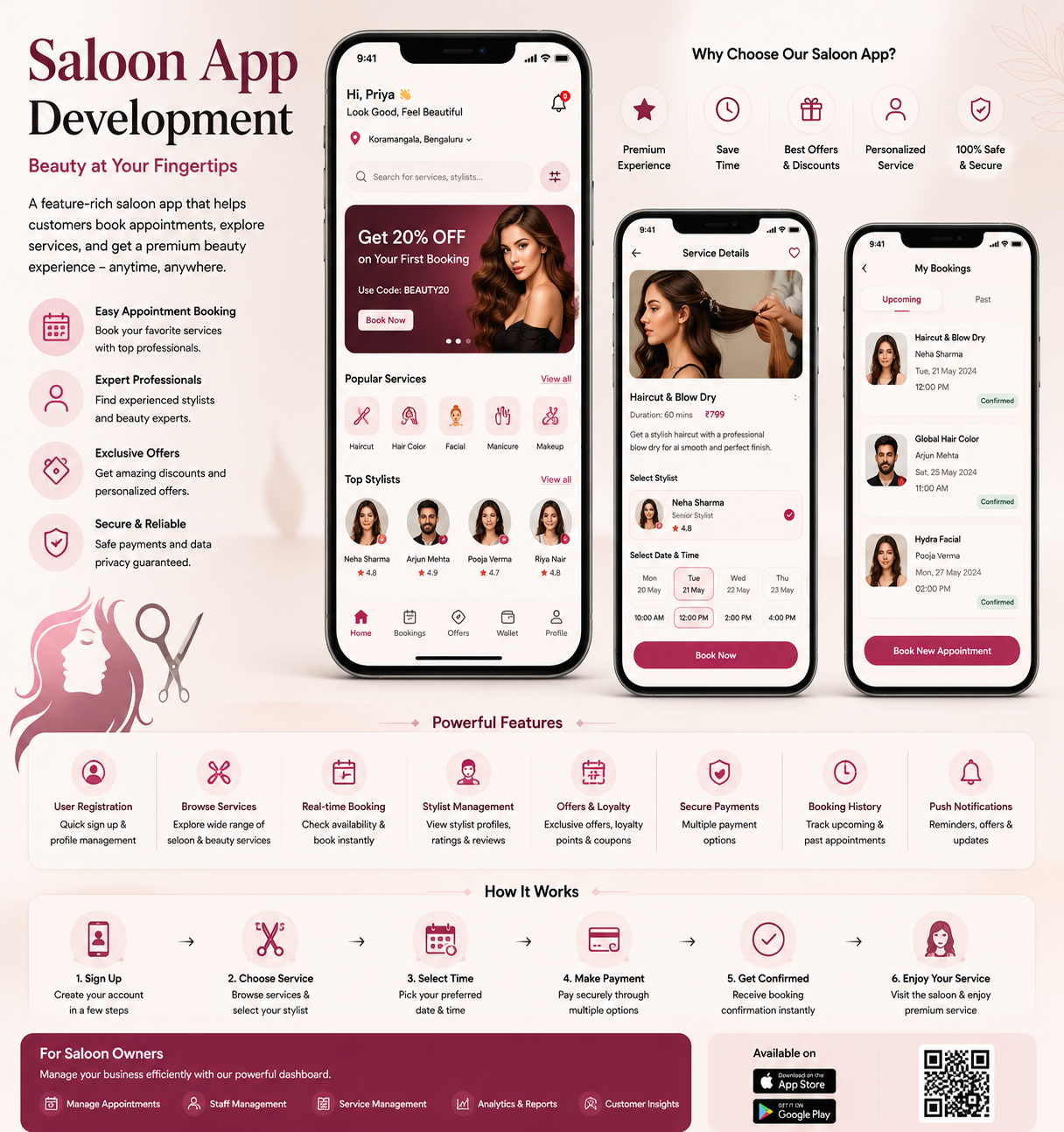
What is a Salon App?
A salon app is a digital platform that transforms the traditional salon experience by enabling customers to discover services, view stylist profiles, book appointments, and manage their visits from their mobile devices . Beyond customer convenience, these apps serve as comprehensive management tools for salon owners, integrating appointment scheduling, staff management, inventory tracking, and client communication .
Key Stakeholders and User Roles
Most salon apps serve three primary user groups with distinct functionalities:
Clients can browse services by category, view real-time availability, book appointments with preferred stylists, receive automated reminders, and build loyalty points. The app serves as a modern, 24/7 booking channel .
Stylists manage their schedules, view assigned services, receive client communication, and track their performance and earnings. Google Calendar integration enables real-time availability .
Administrators have full oversight, managing services, categories, pricing, staff assignments, reporting, analytics, and marketing communications .
Key Features of a High-Performing Salon App
For Clients
- Service Discovery & Booking: Browse services by category, view detailed descriptions, pricing, and duration, and book appointments with real-time availability
- Stylist Selection: View stylist profiles, specialties, and ratings; filter appointments by preferred stylist
- Appointment Management: View upcoming appointments, reschedule or cancel bookings, and receive automated reminders
- Payment Integration: Pay through the app with secure gateways; view transaction history
- Reviews and Ratings: Submit feedback and view reviews for services and stylists
- Push Notifications: Receive reminders, promotional offers, and booking confirmations
- Client Profiles: Maintain history of past services, preferred stylists, and loyalty points
For Salon Owners
- Dashboard & Analytics: Track upcoming appointments, popular services, team performance, and financial reports
- Staff Management: Manage team profiles, schedules, permissions, and performance
- Inventory Management: Track product sales and inventory levels
- Marketing Tools: Send promotional offers and automated reminders via SMS and WhatsApp
- Customer Relationship Management (CRM): View client history and re-engage lapsed customers
- Reports & Insights: Access detailed sales, appointment, and customer reports for data-driven decisions
Technology Stack and Development Approaches
Native vs. Cross-Platform
Salon apps can be built using several approaches, each with distinct trade-offs:
ApproachFrameworksBest ForCross-PlatformFlutter, React NativeCost-effective, reaching both iOS and Android from a single codebase NativeSwift (iOS), Kotlin (Android)Maximum performance and platform-specific featuresNo-Code / Low-CodeAdaloRapid launch with minimal technical expertise, ideal for independent salon owners
Backend Technologies
- Backend: Spring Boot, Django, Laravel, Node.js
- Database: MySQL, PostgreSQL
- Authentication: Firebase Auth, Keycloak (OAuth, JWT)
- Calendar Integration: Google Calendar API for real-time stylist availability
- Payment Gateway: Razorpay, Stripe, Square
- Notifications: Twilio (SMS), Firebase Cloud Messaging (push)
Emerging Technologies
AI-Powered Personalization
Modern salon apps are leveraging AI to enhance the client experience. AI engines store haircut and service history, so users don't need to remember past styles. The app suggests when it's time for a touch-up and recommends styles based on preferences . Advanced platforms are also developing augmented reality (AR) features that allow users to preview haircuts or hair colors virtually before booking .
Microservices Architecture
For scalability, salon apps increasingly adopt microservices architecture, enabling independent deployment of services like booking, user management, and payments .
Development Process
1. Discovery and Feature Definition
Define your app's core purpose. Identify features like appointment booking, payment processing, stylist chat, and notifications. Study competitor apps to differentiate. Map user journeys .
2. UI/UX Design
Designers create wireframes and prototypes focusing on intuitive navigation and brand alignment. Key screens include onboarding, service discovery, stylist selection, booking, and payments .
3. Development
Developers implement the frontend and backend using the chosen technology stack .
4. Integration
Integrate third-party services like payment gateways and calendar APIs for real-time synchronization .
5. QA and Testing
Thoroughly test across devices and scenarios, including performance under traffic, security, and usability .
6. Launch
Publish on the Apple App Store and Google Play Store .
7. Post-Launch Maintenance
Monitor performance, collect user feedback, and release updates with bug fixes and new features .
Cost Considerations
Costs depend on features, complexity, and development approach.
Build vs. No-Code
No-Code Platforms: Build a professional salon app without writing code, costing around $36/month for web, iOS, and Android publishing .
Custom Development: Tailored solutions offer maximum control but require a larger upfront investment.
Cost Drivers
- Platforms: More platforms (iOS, Android, web) increase costs.
- Features: AI-based recommendations and chat are more expensive than basic booking.
- Design: Custom design increases engagement but adds cost.
- Integrations: Payment gateways, notifications, and calendars incur fees.
- Maintenance: Ongoing support and updates are ongoing costs.
Monetization Models
- Subscription: Charge salons a recurring fee for access to the app. Platforms like Goodlii offer tiered plans with advanced analytics and CRM features .
- Freemium: Provide basic features for free and premium upgrades for salons needing advanced tools.
- Commission: Charge a percentage of booking value.
- Per-Seat Pricing: Charge per staff member using the platform .
Conclusion
Salon app development is a strategic opportunity in a growing market. Success depends on understanding the business model and balancing features with technology. The core of the platform lies in a seamless user experience for clients and robust management tools for owners. As the market evolves toward real-time fulfillment and AI-driven personalization, scalability and operational efficiency are critical . Partnering with an experienced team and focusing on delivering genuine value will determine long-term success.