
Dating App Development: Building Connections in the Digital Age
Dating app development is the specialized process of creating digital platforms that facilitate romantic connections between users through features like matching algorithms, real-time messaging, and profile discovery. The modern dating app landscape is at a pivotal moment, projected to be worth billions, yet facing significant challenges in user retention and satisfaction . The industry has reached a point where the largest players, Match Group and Bumble, are seeing a decline in paying subscribers, forcing a shift toward AI and new engagement models to prevent what industry experts call the "cycle of despair"—where users burn out from swiping and ghosting, delete the app, and only return months later .
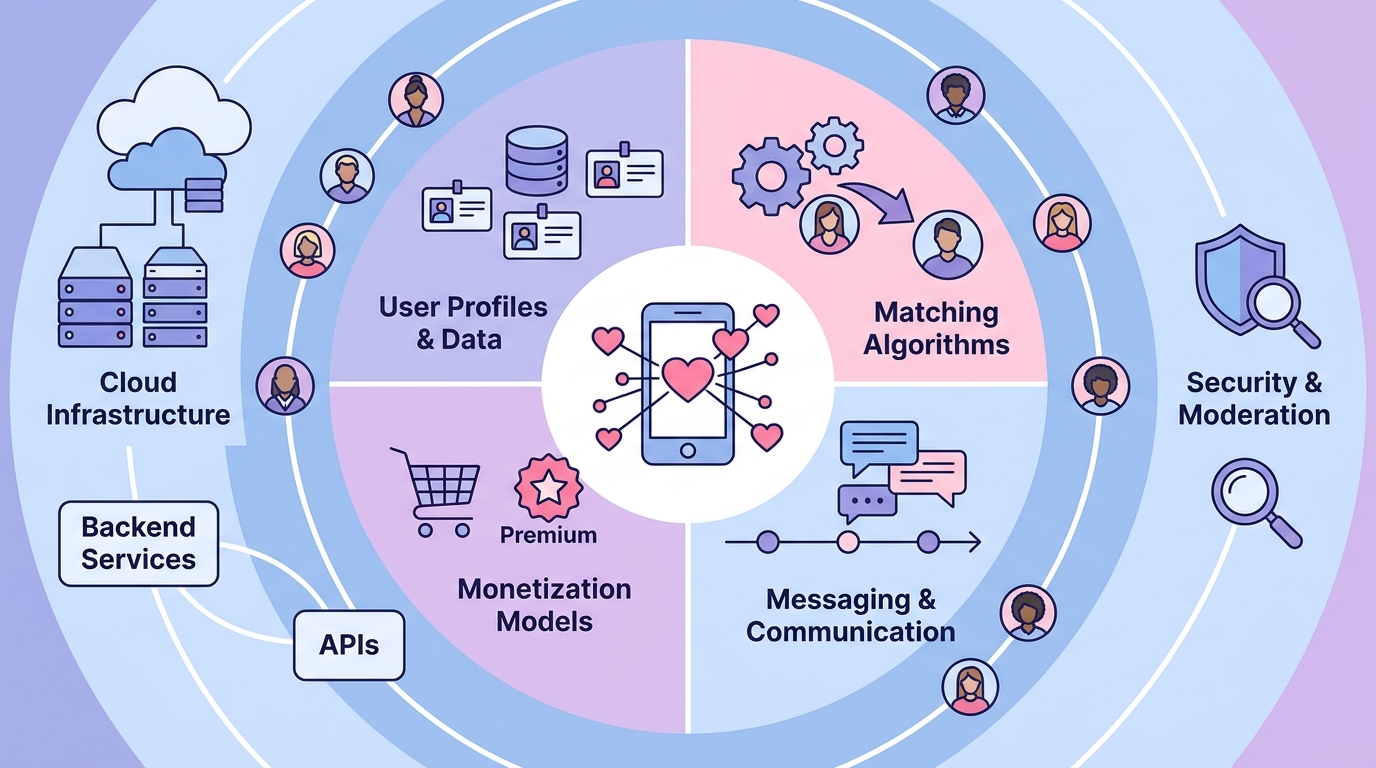
What is a Dating App?
A dating app is a digital platform that connects users seeking romantic, social, or platonic relationships. It serves as a multi-sided marketplace, linking individuals with similar interests, preferences, and location-based proximity.
Core User Roles
- Singles & Daters: The primary users, who create profiles, browse potential matches, engage in conversations, and manage their dating journey. They expect a seamless, engaging, and secure experience.
- Administrators: The platform owners who manage user data, enforce community guidelines, moderate content, and optimize the app's algorithms and monetization strategies.
Key Business Models
The traditional model, where users create free accounts with the option to pay for perks like unlimited swipes or seeing who liked them, is struggling with about 30% of users now paying monthly and a year-over-year decline in paying subscribers . This has led to a search for new monetization approaches, including premium AI matchmakers charging per match instead of a monthly subscription . The ethical challenge remains, as the app's financial incentive is to keep users swiping and paying, even as they promise to help find a lasting match .

Core Features of High-Performing Dating Apps
For Users
- User Profiles: The backbone of the experience, allowing users to showcase personality through photos, bios, prompts, and tags like astrological sign or dating intentions. Features like ID Verification build trust .
- Discovery & Matching: This is often a swipe-based card stack where users can like or pass on profiles. Filters for age, distance, and shared interests allow users to customize their search .
- Real-Time Messaging: Instant communication is the bridge to connection, requiring features like read receipts, typing indicators, and photo sharing. Timely push notifications are critical here .
- Geolocation Services: Using GPS to show nearby matches makes connections more relevant and enables spontaneous meetups .
- Safety & Moderation Tools: Vital for maintaining trust. This includes reporting inappropriate behavior, blocking profiles, and verification options like phone or photo confirmation .
For Engagement & Monetization
- Gamification & Premium Features: Features like super likes, spotlights, unlimited swipes, and seeing who liked you drive monetization and engagement. The now-defunct "Best Photo" feature on Bumble is an example of using data to optimize profile performance . The AI features from Grindr, like an AI "wingman" and AI-generated summaries of people's profiles, are being bundled into premium tiers .
The Development Lifecycle

1. Define Your Niche and Value Proposition
Winning apps target a specific audience or solve a unique problem. Narrowing this down to a specific demographic (e.g., dog lovers, professionals) helps design features that resonate .
2. Market Research & Competitor Analysis
Study established apps like Tinder and Bumble, and understand the market shift toward AI matchmaking. The major apps are internally testing AI tools like dating coaches and AI clones that can date each other, and there's a growing resistance to AI "slop" .
3. Design and Develop
Build the frontend and backend with a focus on core features first. For the frontend, React Native and Flutter offer cross-platform compatibility, while Swift (iOS) and Kotlin (Android) remain the standard for native development . For the backend, Node.js handles real-time data and high concurrency, while Django offers strong security and scalability for complex matching algorithms . Use PostgreSQL or MongoDB for robust data management .
4. Launch and Iterate
Start with an MVP to validate assumptions, gather user feedback, and then progressively add advanced features .
Technology Stack
Frontend Technologies
- React Native: Cross-platform compatibility and reusable components make it a favorite .
- Flutter: Google's UI toolkit known for speed and expressive UI designs, saving development time .
- Swift and Kotlin: Unparalleled for native iOS and Android app performance and hardware integration .
Backend Technologies
- Node.js: Lightweight and efficient for real-time data and high concurrency needs like chat features .
- Django: Python-based, excels in security and scalability for apps with complex functionality .
- Ruby on Rails: Known for rapid development, ideal for building MVPs .
Database Management
- PostgreSQL: A powerful, open-source relational database system .
- MongoDB: A NoSQL database for apps requiring high scalability .
- Firebase: For real-time database services and instant synchronization .
APIs & Cloud Services
- Google Maps API: For geolocation-based features .
- Twilio: For SMS and push notifications .
- AWS Rekognition: For advanced image recognition and moderation .
- Stripe/PayPal: For secure payment processing .
AI & Security
- TensorFlow & PyTorch: For building AI-powered personalized recommendations and chatbots .
- Dialogflow: Google's platform for developing conversational AI interfaces .
- OAuth & JWT: For secure user authentication .
- SSL/TLS Encryption: To protect data during transmission .
Key Challenges and Industry Trends

The AI-Driven Shift
The shift toward AI matchmakers is expected to be the next technological step change . Hinge has reprogrammed its matching algorithm with generative AI, increasing matches by 15%, and Bumble plans to release an AI matchmaking app . Apps are now allowing users to describe their ideal match in natural language .
The "Cycle of Despair" and User Retention
A major challenge is the "cycle of despair," where users burn out and delete apps . A 2025 survey found 78% of respondents reported feeling emotionally or mentally exhausted by dating apps . The market's structure, dominated by Match Group and Bumble, creates an environment where apps may be designed to keep users swiping and paying rather than finding love .
Conclusion
Dating app development is a rapidly evolving field where success depends on creating a compelling user experience, navigating a complex business landscape, and integrating cutting-edge technology like AI. The future is likely to see a move away from endless swiping toward more curated, AI-assisted matchmaking, potentially charging per quality match rather than monthly subscriptions.