
Bulk Transactional Email Services: The Engine of Critical Communications
Bulk transactional email services are specialized platforms designed to send automated, high-volume, one-to-one emails triggered by user actions . Unlike marketing email services built for bulk campaigns, these platforms are optimized for speed, reliability, and near-instant delivery of critical communications like order confirmations, password resets, and shipping notifications . If these emails fail to land in the inbox immediately, user experience suffers, support tickets spike, and revenue can be lost.
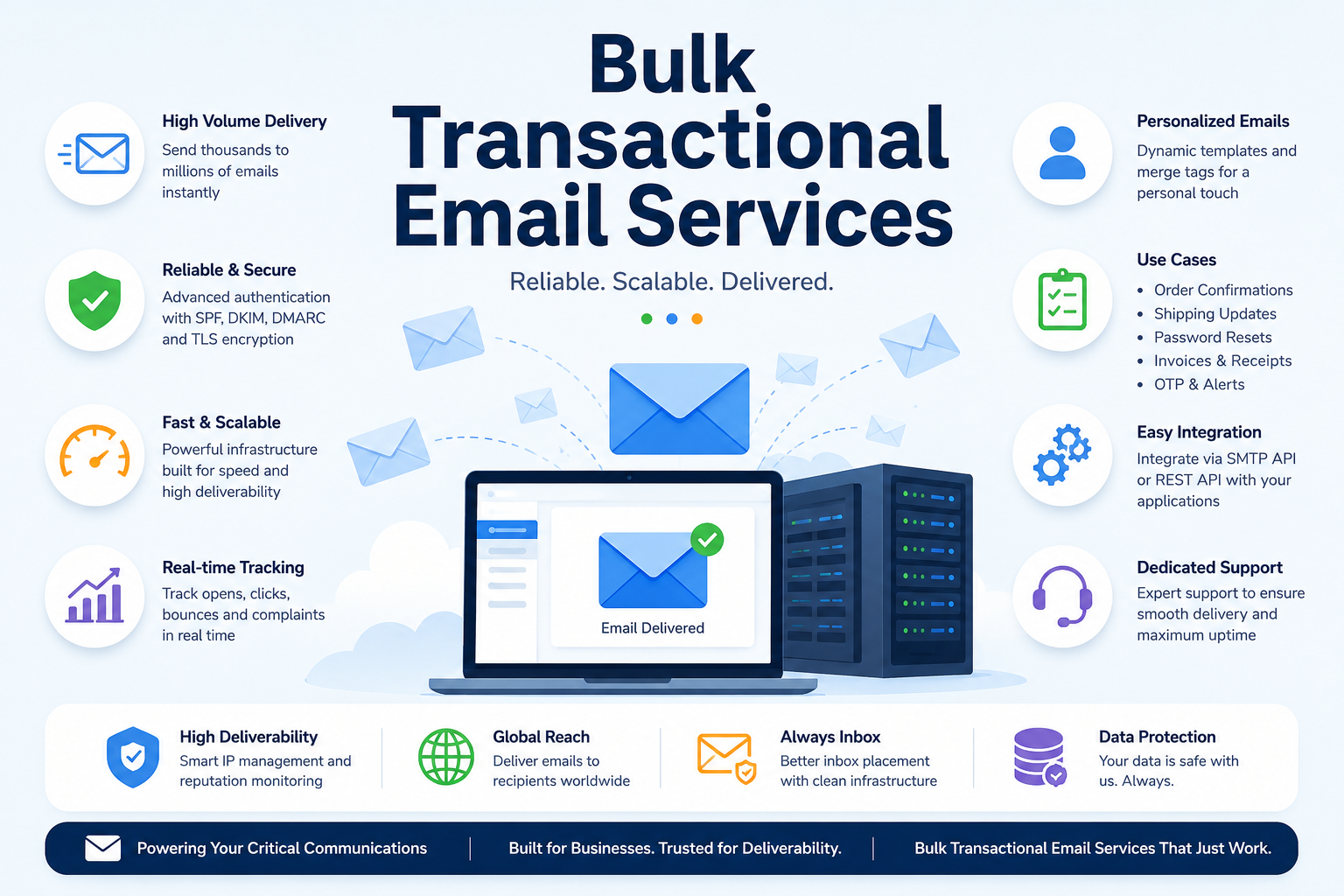
What Makes a Transactional Email Service?
Why You Need a Dedicated Platform
You could try to send these emails through your web host or a standard Gmail account, but this is strongly discouraged for several reasons :
- Speed: Standard servers often have queues. Transactional email services are built to deliver in seconds .
- Deliverability: Specialized providers work constantly to keep their IP addresses clean so your important emails don't land in spam .
- Analytics: You need to know exactly why a password reset bounced. Dedicated tools provide detailed logs .
- Infrastructure Separation: If you send marketing blasts and transactional alerts from the same IP address, a marketing campaign getting marked as spam could drag down your reputation, causing your password resets to be blocked too . Advanced services allow you to manage both types of email safely from one interface while separating sender reputation behind the scenes .
Transactional vs. Marketing Email
FeatureTransactional EmailMarketing EmailIntentDelivers critical information the user requested. Typically achieves 42% higher click rates than marketing emails .Designed to convert or engage (newsletters, promotions) .PermissionGenerally does not require an unsubscribe link because they are essential to the service .Strictly requires opt-in consent and must include an unsubscribe link .InfrastructureRequires separation to protect sender reputation .Can be sent from shared or dedicated infrastructure .
Leading Providers at a Glance
Based on extensive testing and comparison, here are the top providers, with their primary strengths and starting prices :
ProviderPrimary EdgeEntry PricePostmarkBest deliverability (83.3% inbox rate) & speed $15/mo for 10,000 emails MailtrapFast setup, best analytics & 99.99% uptime SLA $15/mo for 10,000 emails BrevoAll-in-one platform (marketing + transactional) $9/mo for 5,000 emails MailgunDeveloper-centric with powerful APIs $15/mo for 10,000 emails Amazon SESUnrivaled cost-efficiency $0.10 per 1,000 emails SendGridMassive scale & marketing ecosystem $19.95/mo for 50,000 emails
Deep Dive into Key Providers

Postmark: The Champion of Speed and Deliverability
Postmark has carved out a strong niche by focusing obsessively on one metric: speed to the inbox . They famously do not allow promotional email marketing on their platform, believing that bulk marketing sends can degrade the IP reputation infrastructure used for critical transactional alerts . In independent deliverability testing, Postmark achieved an 83.3% inbox placement rate, the highest among the providers tested .
Key Features:
- Message Streams: Separate transactional and bulk sending streams to keep reputations isolated .
- Sub-second delivery latency: Optimized for near-instant notification delivery .
- 45-day email log retention: Detailed searchable history for troubleshooting .
- Bulk API: Send personalized emails to thousands of recipients with a single API call .
Best For: SaaS platforms prioritizing speed, reliability, and deliverability .
Mailgun: The Developer's Choice
Mailgun is built primarily for developers, by developers . It focuses heavily on powerful APIs and intricate routing capabilities rather than visual aesthetics or marketing tools . It is ideal for technical teams building complex applications that require sophisticated handling of both outbound and inbound emails .
Key Features:
- Robust API: Allows for complex inbound email routing, parsing incoming messages into JSON data for applications to process .
- Email Validation: Built-in email validation features to clean lists in real-time at the point of signup .
- Granular Logs: 30-day log retention, vital for debugging delivery issues .
- Send Time Optimization (STO): AI-driven optimization for better engagement .
Best For: API-first engineering teams building complex applications .
Mailtrap: The Complete Platform for Scale
Mailtrap is a transactional email service built for developers and product teams to send emails at scale . It provides a transactional email API and SMTP relay with a focus on high inbox rates, industry-best analytics, and fast integration . Trusted by companies including PayPal, Atlassian, and Adobe .
Key Features:
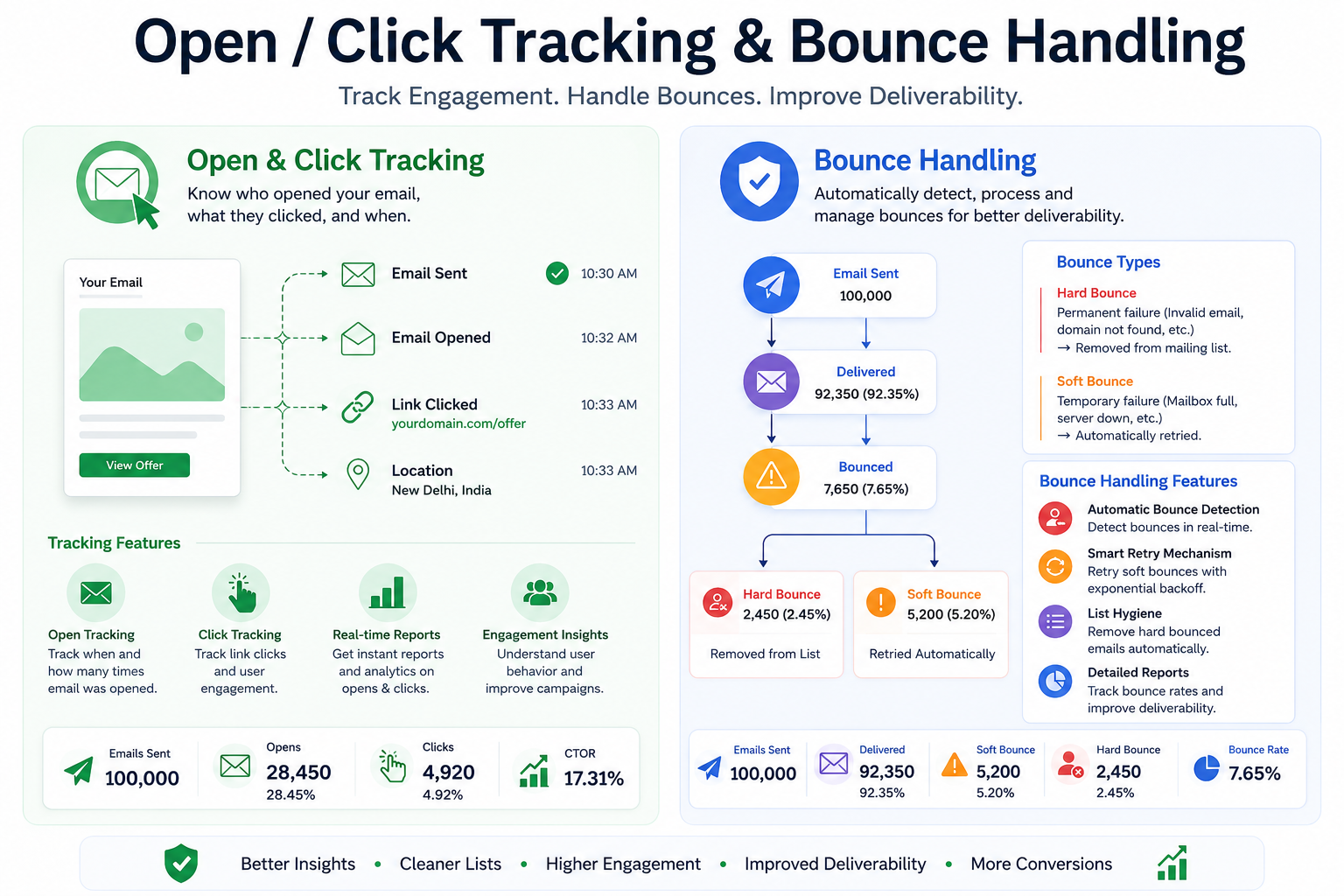
- Industry-Best Analytics: Includes metrics such as delivered emails, unique open rate, click rate, bounce rate, spam complaints, and unsubscribing on all plans with no add-ons required .
- Dedicated IPs with Automatic Warmup: Available on Business and Enterprise plans .
- Separate Sending Streams: Prevent bulk sends from impacting transactional reputation .
- 99.99% Uptime SLA: Maintains high reliability .
- MCP Server: Codeless integration with AI tools like Claude Code or Cursor .
Best For: Companies sending at scale looking for high email deliverability and industry-best analytics .
Amazon SES: The Cost-Effective Infrastructure
Amazon SES is the cloud infrastructure giant's entry into email sending. It is unrivaled in terms of raw cost-efficiency, offering the lowest price per thousand emails on the market . However, SES is a bare-bones infrastructure service . It does not provide friendly user interfaces, template builders, or detailed analytics dashboards without significant additional development work .
Key Features:
- Lowest Cost: $0.10 per 1,000 emails .
- Infinite Scalability: As part of the AWS infrastructure .
- Deep Integration: For teams already using the AWS stack (Lambda, S3, CloudWatch) .
- Virtual Deliverability Manager (VDM): Paid add-on for analytics .
Best For: AWS-heavy technical teams with the capacity to manage configuration and deliverability independently .
Deliverability: The Critical Metric
Deliverability is the most important factor in choosing a transactional email provider. If your emails land in spam, they might as well not have been sent. Independent testing provides a clear picture of how providers perform on shared IPs :
ProviderInbox RateSpam RatePostmark83.3%14.3%Mailtrap78.8%14.4%Amazon SES77.1%20.0%Mailgun71.4%23.8%SendGrid61.0%17.1%
Note: Your own sending practices, domain authentication, and IP type also affect your results .
Cost Comparison: What You'll Actually Pay
Pricing varies significantly between providers. Here's what you'll pay for typical monthly volumes :
Provider20,000 emails50,000 emails100,000 emailsAmazon SES$2$5$10Brevo$29$55$69Mailgun$35$35$75Mailtrap~$25~$55$85Postmark$55$55$115-$138SendGrid$19.95$19.95$34.95
Note: Amazon SES requires AWS technical expertise for setup; HubSpot's transactional email add-on requires a $1,490/month Marketing Hub Professional plan .
How to Choose the Right Provider
- Choose Postmark when delivery speed is non-negotiable and you want a provider with a strong reputation across both transactional and bulk sending .
- Choose Mailtrap when deliverability and analytics are your top priorities and you want the fastest setup with a complete platform that scales from day one .
- Choose Mailgun when you need granular API control, advanced routing, or email validation built into your infrastructure .
- Choose Amazon SES when cost per email is the primary constraint and your team has the technical capacity to manage configuration and deliverability independently .
- Choose Brevo when you want a unified CRM and transactional platform for your SMB .
Security and Compliance
You need to prioritize security and compliance to protect sensitive data and maintain customer trust. Compliance and security lapses can turn into multi-million-dollar fines . Key certifications to look for:
- ISO 27001: International standards for information security management systems .
- SOC 2 Type II: Evaluates the effectiveness of security controls over time .
- GDPR Compliance: For EU residents' data protection .
- HIPAA Compliance: For healthcare data in the U.S. .

Conclusion
Bulk transactional email services are the backbone of secure, reliable, and scalable digital customer experiences. They allow businesses to automatically send high-volume, critical communications that users have come to expect—all while maintaining high deliverability and respecting user privacy. The key to success lies in understanding your specific needs for deliverability, developer experience, cost, and security, and choosing a provider that aligns with those priorities.
No single provider wins across every category—the right choice depends on where your priorities sit across deliverability, cost, developer experience, and support