
OTT App Development: Building the Future of Video Streaming
OTT (Over-the-Top) app development is the specialized process of creating platforms that deliver video, audio, and other media content directly to users over the internet, bypassing traditional cable, satellite, or broadcast television networks . In an era where audiences have shifted from scheduled programming to on-demand, personalized viewing, OTT platforms have become the dominant model for video consumption. The global OTT market is projected to exceed $400 billion by 2028, driven by increased smartphone penetration, affordable data, and a growing appetite for niche and regional content .
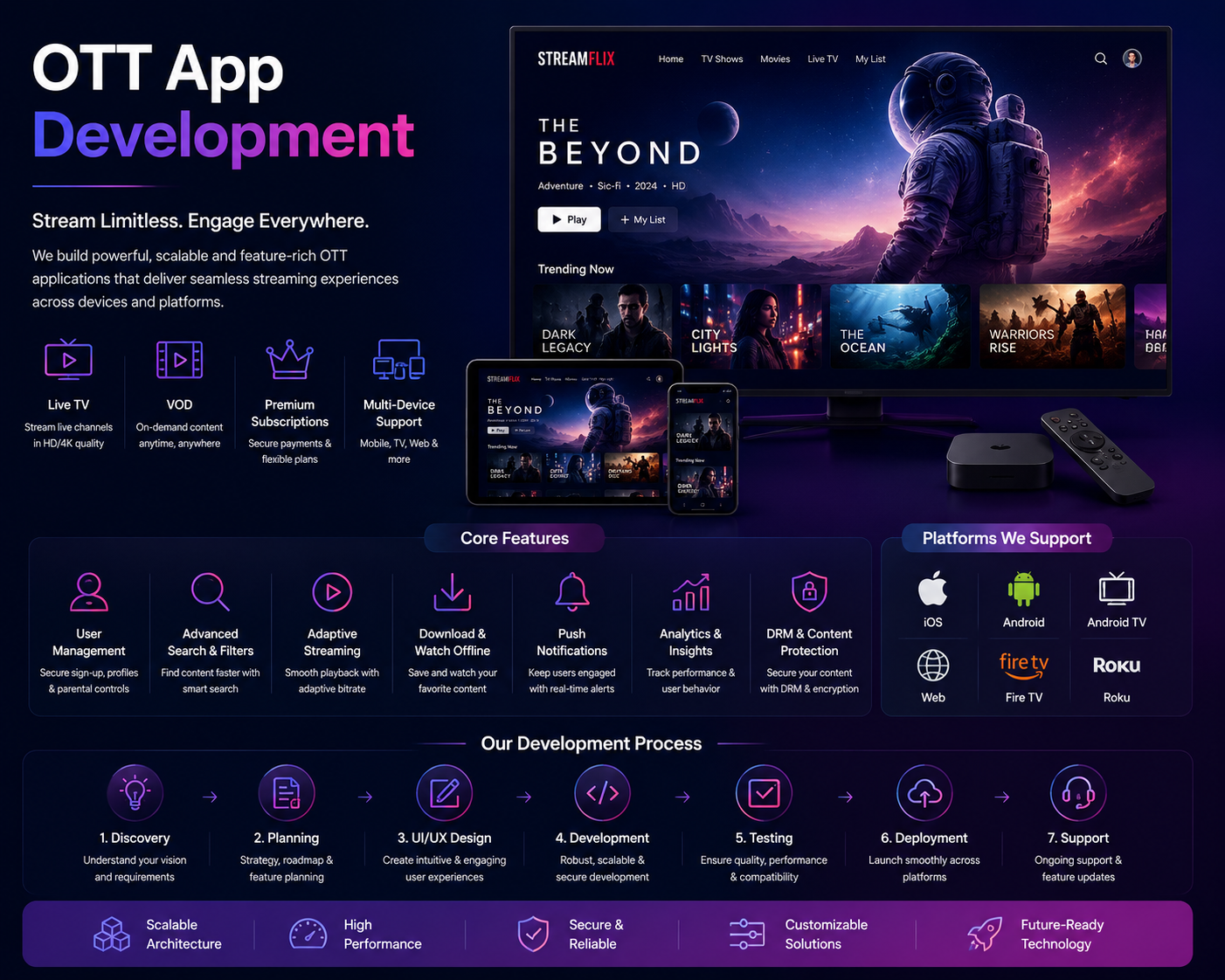
From established giants like Netflix and Amazon Prime Video to niche services for fitness, education, or faith-based communities, OTT development enables content creators, broadcasters, and businesses to reach global audiences, own their content, and monetize directly .
What is OTT App Development?
OTT app development is the process of building applications that stream video content over the public internet. Unlike IPTV, which operates on closed, operator-controlled networks, OTT platforms prioritize reach, device diversity, and flexibility . An OTT platform is not just a video player—it is a complex operational ecosystem that combines content management, delivery, monetization, personalization, and analytics into a unified system .
Behind the "play button," a production OTT platform typically spans several engineering layers:
- Frontend Applications: Native or cross-platform apps for mobile (iOS/Android), web, and connected TV environments (Roku, Fire TV, Apple TV, Samsung Tizen, LG webOS). Each is a separate engineering context with its own SDK, performance constraints, and certification process .
- Backend and API Layer: Handles authentication, content cataloging, user profiles, recommendations, search, analytics, and integrations with billing, ad, or CRM systems .
- Content Management System (CMS): Enables uploading, transcoding, tagging, scheduling, and managing metadata at scale .
- Monetization Infrastructure: Subscription management, payment gateways, ad server integration, or transactional purchase flows .
- Content Protection: Multi-DRM (Widevine, FairPlay, PlayReady), and sometimes forensic watermarking, to prevent piracy .
- Delivery Infrastructure: CDN configuration, adaptive bitrate (ABR) transcoding pipelines, and origin storage .
The OTT App Development Lifecycle
Building a successful OTT platform is a strategic initiative that spans product, technology, and commercial teams .
Phase 1: Define Vision and Content Strategy
Start by defining a clear niche and content strategy . Ask yourself:
- What type of content will you stream (movies, TV shows, live sports, educational content, fitness, etc.)?
- Who is your target audience?
- Do you have the rights to the content? For licensed studio content, multi-DRM implementation is required before licensing negotiations can begin .
Phase 2: Choose Business and Monetization Model
Selecting the monetization model is a technical architecture decision as much as a pricing strategy .
ModelDescriptionBest ForSVOD (Subscription Video on Demand)Users pay a recurring fee for unlimited access .Steady revenue, audience retention (Netflix, Disney+)AVOD (Ad-Supported Video on Demand)Content is free but ad-supported .Large, price-sensitive audiences (YouTube, Tubi)TVOD (Transactional Video on Demand)Users pay per movie/show (pay-per-view or rentals) .Exclusive or event-based content (iTunes)HybridCombination of SVOD, AVOD, and/or TVOD .Revenue diversification, premium ad-free tiers
Phase 3: Choose Development Approach
You have several options for building your OTT platform:
- Native Development: Build separate apps for each platform (Swift for iOS, Kotlin for Android). Offers the best performance and access to platform-specific features but is resource-intensive .
- Cross-Platform Development: Use frameworks like React Native or Flutter to write one codebase that runs on multiple platforms. This balances performance and efficiency, accelerating time-to-market . Expo, a React Native framework, is increasingly popular, offering tools like Expo Go for instant preview and Over-The-Air (OTA) updates .
- White-Label OTT Platforms: Off-the-shelf solutions that can be branded and customized. Accelerate time to market but may limit differentiation and data ownership .
Phase 4: Design and Development
- Prioritize UX for Mobile: Mobile accounted for over 62% of global web traffic as of January 2025 . Design for touch interactions, smaller screens, and on-the-go usage. Curate content thumbnails in portrait mode, and consider shorter, easily digestible formats .
- Optimize Data Usage and Battery Life: Implement adaptive streaming (HLS or DASH) and modern codecs like HEVC to reduce data consumption . Manage background processes and use hardware acceleration to save battery life .
- Select the Right Tech Stack: A robust backend is crucial.
- Frontend: React Native, Flutter, Swift (iOS), Kotlin (Android) .
- Backend: Node.js, Django, PHP .
- Database: PostgreSQL, MongoDB .
- Cloud & CDN: AWS, Google Cloud, Akamai .
- DRM: Google Widevine, Apple FairPlay, Microsoft PlayReady .
Phase 5: Testing and Launch
- Test Across All Devices: Ensure compatibility across mobile, web, and Smart TV platforms. Each Smart TV environment—Roku, Samsung Tizen, LG webOS, Apple TV—requires its own testing matrix and certification submission .
- Track Key Metrics: Effective OTT strategies focus on metrics like time-to-first-play, content completion rates, session depth, churn indicators, and ad load tolerance .
Cost Drivers and Estimates
OTT app development costs are driven primarily by four independent multipliers: platform count, business model complexity, content delivery infrastructure scope, and DRM requirements .
Platform Count: The Biggest Multiplier
Each additional platform—especially Smart TV environments—adds 15–30% to the build cost . Roku, Fire TV, Apple TV, Samsung Tizen, and LG webOS are not interchangeable; they have different SDKs, memory constraints, interaction models (remote-first vs. touch-first), and certification processes .
Platform TierPlatforms CoveredEstimated Build CostTimelineMobile OnlyiOS and Android$80K–$180K5–9 monthsMobile + WebiOS, Android, Web$120K–$240K7–12 monthsMid-Tier EcosystemiOS, Android, Web, Roku$180K–$320K9–14 monthsFull EcosystemiOS, Android, Web, Roku, Fire TV, Apple TV$280K–$500K12–18 monthsComplete Multi-PlatformAll of the above + Samsung Tizen + LG webOS$400K–$800K15–22 months
Ongoing Infrastructure Costs
- CDN, Transcoding, and Storage: Costs scale with viewer hours and can add $5,000 to $50,000+ per month at scale .
- DRM and Security: Multi-DRM implementation adds $20,000–$50,000 to the build cost for any platform requiring licensed studio content .
Key Features of Modern OTT Apps
- User Profiles & Personalization: Let users create profiles, save watchlists, and receive AI-driven content recommendations .
- Multi-Device Support: Seamless functionality across mobile, web, and TV platforms .
- Adaptive Video Streaming: Auto-adjusts video quality based on internet speed .
- Content Management System: A robust backend to upload, organize, and manage video content .
- Monetization Modules: Support for AVOD, SVOD, TVOD, freemium models, and hybrid monetization .
- Secure DRM & Authentication: Protect content from piracy using Digital Rights Management and login-based access .
- Offline Viewing: Allows users to download videos over Wi-Fi and watch them later without constant data usage, particularly valuable in markets with limited data plans .
Conclusion
OTT app development is a high-stakes, high-reward endeavor that requires careful strategic, technical, and commercial planning. Success depends on defining a clear content niche, selecting the right monetization model, and building a scalable, multi-platform architecture. The most resilient OTT platforms are designed to adapt as audience expectations and business models evolve .
By partnering with an experienced OTT development team and leveraging modern frameworks, cloud infrastructure, and monetization technologies, content creators and businesses can build platforms that engage global audiences, own their content, and build direct, lasting relationships with their viewers